

Propane and electric patio heaters warm people in different ways and fit different patios. Propane heaters are free-standing and bring their own fuel, while electric heaters need an outlet and, often, a place to mount them.
This guide compares the two with listing examples. For picks, see our Best Propane Patio Heaters and Best Electric Patio Heaters.
How They Work
Propane heaters
A propane heater burns gas from a tank to heat a reflector or a flame tube. The EAST OAK listing describes a 50,000 BTU heater with one-hand ignition, a built-in table and wheels, and it needs a tank that is not included.

EAST OAK 50,000 BTU Propane Patio Heater


As an Amazon Associate we earn from qualifying purchases. Product prices and availability are accurate as of the date/time indicated.
Electric heaters
An electric infrared heater turns power into radiant heat with a carbon fiber or quartz element, so there is no flame or fuel to refill. The NEWBULIG listing describes a 1500W wall-mounted heater with a remote, a timer and a mounting bracket.

NEWBULIG 1500W Wall-Mounted Infrared Heater


As an Amazon Associate we earn from qualifying purchases. Product prices and availability are accurate as of the date/time indicated.
How They Differ
| Propane | Electric | |
|---|---|---|
| Power source | Propane tank | Outlet (or wiring for some models) |
| Placement | Free-standing, wheeled | Wall, ceiling or tower, near an outlet |
| Heat feel | Radiant heat over a wider circle (maker claims) | Directed warmth over a smaller zone |
| Wind | Wind can blow the heat away | Directed heat holds up better in light wind, but still loses heat in wind |
| Carbon monoxide | Produces it, so open air only | Does not produce it |
| Setup | Tank hookup and level ground | Mounting point and outlet |
Heat output and coverage figures in listings are the makers' own claims, and wind, air temperature and placement change how warm you feel.
Which Fits Your Patio
Choose propane if
- You want a heater you can roll to different spots
- The seating is in open air with no outlet nearby
- You are comfortable handling and storing a propane tank
Choose electric if
- You have a solid wall, ceiling or gazebo frame to mount on
- You want no fuel to buy or refill
- You want a heater that you can switch on from a remote
A third option
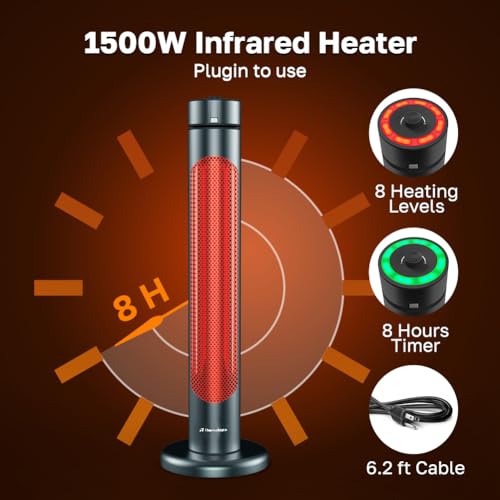
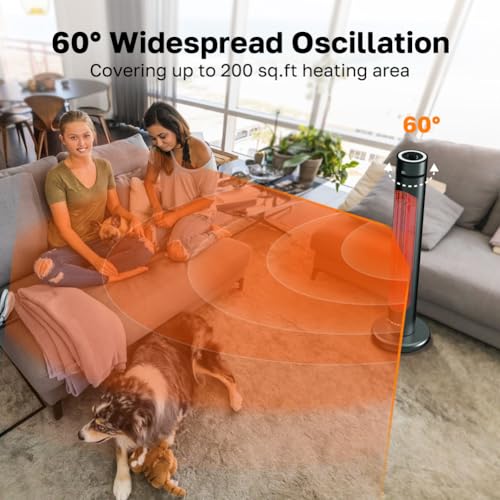
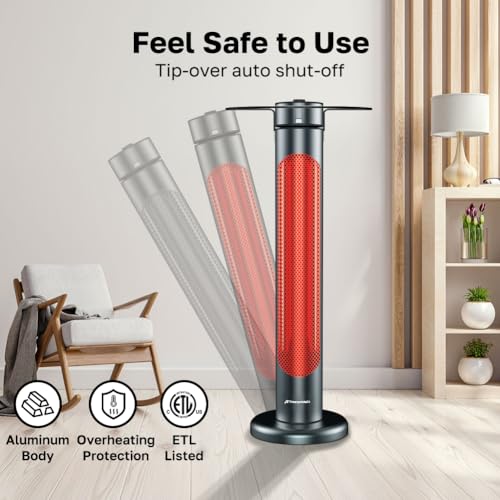
A plug-in tower such as the ThermoMate gives an electric heater without wall mounting. The listing describes a 1500W oscillating tower with a remote and an eight-hour timer.

ThermoMate 1500W Electric Infrared Patio Heater


As an Amazon Associate we earn from qualifying purchases. Product prices and availability are accurate as of the date/time indicated.
Safety for Both Types
Whatever type you choose, follow the manufacturer's manual for clearances, placement and fuel or power hookup. Burning fuel produces carbon monoxide, so a fuel-burning heater belongs outdoors in an open, well-ventilated area, never in a garage, tent or other enclosed or covered space unless the manual explicitly allows it. Local fire codes, HOA rules and restrictions on heater use vary, so check them where you live.
FAQ
Which is warmer, propane or electric?
Propane heaters list higher outputs, but electric infrared warms people directly. What you feel depends on wind, temperature and placement.
Do electric patio heaters make carbon monoxide?
No. Electric heaters do not burn fuel.
Can I use a propane heater under a roof?
Only if the manual explicitly allows it. Burning fuel produces carbon monoxide.
Do electric heaters work in the rain?
Some carry a weather rating, which is the maker's claim. Read the manual for allowed conditions.
Related Picks and Reviews
Best lists: Best Patio Heaters Under $200, Best Patio Heaters Under $100. Reviews: EAST OAK 50,000 BTU Propane Patio Heater with Round Table Review, ThermoMate 1500W Oscillating Infrared Patio Heater Review. More comparisons: Freestanding vs Tabletop vs Wall-Mounted Patio Heaters, Propane vs Natural Gas Patio Heaters.
The Bottom Line
Choose propane for a free-standing heater in open air, and electric for a mounted or plug-in heater near power. Heat output and coverage figures in listings are the makers' own claims, and wind, air temperature and placement change how warm you feel.
Check the manual and local rules before you place any heater.


Write Your Review
No reviews yet. Be the first to share your experience!